Queues
Long calling waits have an undeniably negative impact on your customer’s experience. For 66% of callers, two minutes on hold is their breaking point. Queues are fundamental in managing high call volumes to ensure no customer goes unattended. They offer the same call routing features as hunt groups but also allow incoming calls to wait in a virtual queue for the next available agent to take the call.
Queues offer a unique opportunity to provide informative greetings and announcements that keep callers engaged and help minimize missed or abandoned calls. Up to three Queue Announcements, which are managed in the Media Files library, can be assigned to a queue to fully customize the experience.
Callers can reach a queue by dialing the assigned phone number or extension, or via an auto-attendant. Any auto-attendants it's assigned to are listed at the bottom of the queue configuration. See Route Calls to a Hunt Group or Queue for details.
Add or Edit a Queue
Queues can be modified at any time, without duplicating or deactivating the auto-attendant it's assigned to. That means you can add or remove users, log users in or out, change the announcements, and more, as needed.
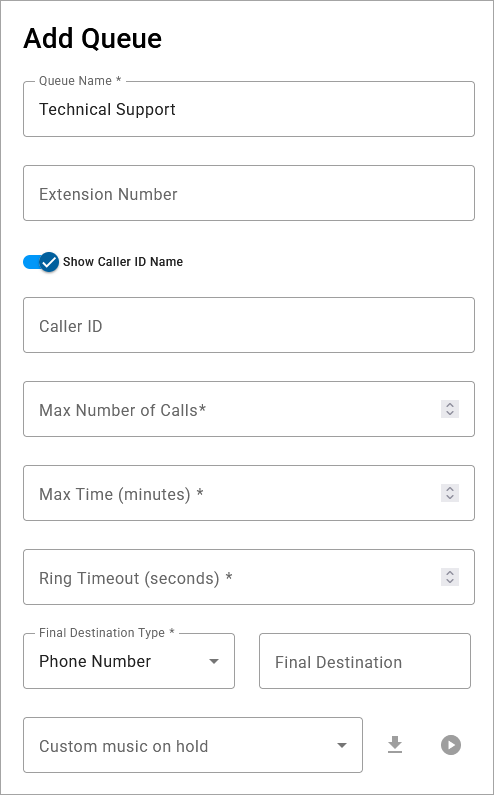
Follow these steps to create or modify a queue:
Go to Call Groups and select the Queues tab.
Click [+ Add Queue] or select an existing queue from the list.
In the popup window, enter the following information:
Setting
Description
Queue Name
Enter a unique name for the group.
Extension Number
Assign a unique extension to the group (optional). The extension must not start with 0 or 911.
Note
Callers can reach the queue directly via an extension (entered here) or phone number. To assign a phone number to the queue, see Change Phone Number Destination.
Show Caller ID Name
Toggle on to show a name for this group in caller ID, then enter a custom name in the field below. It can, but does not have to be, the same as the group name.
When the call is delivered to a user, the caller ID will show this name before the caller's name and phone number. For example: Sales JANE SMITH 18015551234.
If the call is routed through multiple call groups, only the most recent group's name is displayed. There are no character limitations for the caller ID name, but a shorter name will allow more to be shown on the device screen.
Max Number of Calls
Enter the number of calls that can be in the queue at one time (1–50).
Max Time (minutes)
Enter the number of minutes that a call is allowed to be in the queue (1–360). Once the max time is reached, the call is sent to the Final Destination or auto-attendant failure route.
Ring Timeout (seconds)
Enter the number of seconds a call will ring to a user or group before it is pushed back to the front of the queue (5–120). Keep this low to ensure calls are answered quickly. See User Ring Strategy for details.
Final Destination
Enter the failure route for calls that reach the group directly (via phone number or extension) and are not answered. Select Phone Number or Extension, then enter the number in the field to the right.
Calls that reach this call group from an auto-attendant follow the auto-attendant's failure route, not the Final Destination.
Custom music on hold
Select a custom Music On Hold file from the Media Files library that will play when a call is answered and then placed on hold. If this is not configured, the caller will hear the hold music assigned to the user (if configured) or the account.
Queue Announcements are a series of prompts and messages that callers hear when they reach the queue. To customize the caller experience, choose an Intro Prompt, Primary Message, and an Interrupt message from the Media Files library.
Each prompt is optional, though a Primary message is recommended. If a Primary message is not selected, the caller will hear Music On Hold.
Choose whether to allow users in the group to turn calls on and off via star code.
Choose how incoming calls will ring to users in the group: Simultaneous, Sequential, Round Robin, or Longest Idle.
Choose if users in the group can log in and out via star code.
When you're done, click [Save].
See also: Route Calls to Hunt Group or Queue